To contact us Click HERE
New research from the University of Copenhagen and Copenhagen University Hospital shows that low levels of vitamin D are associated with a markedly higher risk of heart attack and early death. The study involved more than 10,000 Danes and has been published in the well-reputed American journal Arteriosclerosis, Thrombosis and Vascular Biology.
Vitamin D deficiency has traditionally been linked with poor bone health. However, the results from several population studies indicate that a low level of this important vitamin may also be linked to a higher risk of ischemic heart disease, a designation that covers heart attack, coronary arteriosclerosis and angina. Other studies show that vitamin D deficiency may increase blood pressure, and it is well known that high blood pressure increases the risk of heart attack.
"We have now examined the association between a low level of vitamin D and ischemic heart disease and death in the largest study to date. We observed that low levels of vitamin D compared to optimal levels are linked to 40% higher risk of ischemic heart disease, 64% higher risk of heart attack, 57% higher risk of early death, and to no less than 81% higher risk of death from heart disease," says Dr. Peter Brøndum-Jacobsen, Clinical Biochemical Department, Copenhagen University Hospital.
The scientists have compared the 5% lowest levels of vitamin D (less than 15 nanomol vitamin per litre serum) with the 50% highest levels (more than 50 nanomol vitamin per litre serum). In Denmark, it is currently recommended to have a vitamin D status of at least 50 nanomol vitamin per litre serum.
The higher risks are visible, even after adjustment for several factors that can influence the level of vitamin D and the risk of disease and death. This is one of the methods scientists use to avoid bias.
Blood samples from more than 10,000 Danes
The population study that forms the basis for this scientific investigation is the Copenhagen City Heart Study, where levels of vitamin D were measured in blood samples from 1981-1983. Participants were then followed in the nationwide Danish registries up to the present.
"With this type of population study, we are unable to say anything definitive about a possible causal relationship. But we can ascertain that there is a strong statistical correlation between a low level of vitamin D and high risk of heart disease and early death. The explanation may be that a low level of vitamin D directly leads to heart disease and death. However, it is also possible that vitamin deficiency is a marker for poor health generally," says Børge Nordestgaard, clinical professor at the Faculty of Health and Medical Sciences, University of Copenhagen and senior physician at Copenhagen University Hospital.
Long-term goal is prevention
The scientists are now working to determine whether the connection between a low level of vitamin D and the risk of heart disease is a genuine causal relationship.
If this is the case, it will potentially have a massive influence on the health of the world population. Heart disease is the most common cause of adult death in the world according to the World Health Organization (WHO), which estimates that at least 17 million people die every year from heart disease.
"The cheapest and easiest way to get enough vitamin D is to let the sun shine on your skin at regular intervals. There is plenty of evidence that sunshine is good, but it is also important to avoid getting sunburned, which increases the risk of skin cancer. Diet with a good supply of vitamin D is also good, but it has not been proven that vitamin D as a dietary supplement prevents heart disease and death," says Børge Nordestgaard.
28 Eylül 2012 Cuma

Eunuchs outlive other men
To contact us Click HERE
Castrated men living in Korea centuries ago outlived other men by a significant margin. The findings, reported in the September 25 issue of Current Biology, a Cell Press publication, suggest that male sex hormones are responsible for shortening the lives of men, the researchers say.
The evidence comes after careful study of genealogy records of noble members of the Imperial court of the Korean Chosun dynasty (AD 1392-1910).
"This discovery adds an important clue for understanding why there is a difference in the expected life span between men and women," said Kyung-Jin Min of Inha University.
The castrated boys in Korea lost their reproductive organs in accidents—usually after being bitten by dogs—or underwent castration purposefully to gain early access to the palace. Eunuchs were allowed to marry and had families by adopting castrated boys or normal girls.
People in those days kept careful genealogy records as proof that they were of the noble class. By poring over those records, Min and colleague Cheol-Koo Lee of Korea University found that eunuchs lived 14 to 19 years longer than other men did. Amongst the 81 eunuchs they studied, three lived to the ripe old age of 100 or more, a feat of longevity that remains relatively rare even in developed countries today.
The incidence of centenarians among Korean eunuchs is at least 130 times greater than it is in the developed countries, Lee notes, and that can't be explained simply by the benefits of life in the palace, either. Most eunuchs spent as much time outside the palace as they did inside it. And, in fact, kings and male members of the royal family had the shortest lives of all, typically surviving only to their mid-forties.
The findings may offer some clues to life extension and, in the meantime, men might take heed, Min and Lee quip. "For better health and longevity, stay away from stresses and learn what you can from women."
Eating fish may reduce the risk of heart attack, but watch out for mercury
To contact us Click HERE
Eating fish may reduce the risk of heart attack, but it is important to steer clear from the type of fish that contains the most amounts of mercury, according to experts from Umeå University in Sweden.
The researchers have worked together with teams from Finland and other countries in order to assess whether the advantages of heathy fatty acids outweigh the risks of mercury proportion.
Previous research has said that individuals who consume fish have a decreased risk of heart disease, compared to those who eat none or very little. However, certain types of fish carry pollutants from the environment, which can be detrimental to the health of humans.
Methyl mercury, which can be found in many types of fish, may actually raise the risk of cardiovascular disease. Therefore, consuming fish with a lot of mercury, or with ample amounts of pollutants, can severely increase the risk of heart problems. However, if people are too health conscious of fish, they increase their risk of the disease because they are not receiving the benefits of healthy fish.
A recent study said that tuna, which has high levels of mercury, should be given to children less often.
The current research, which will be published in the October 2012 issue of American Journal of Clinical Nutrition (AJCN), was carried out with the intention of finding a middle point between not eating any fish and eating too much, or types that are unhealthy.
The authors analyzed why heart attack risk is linked to the amount of mercury and omega-3 fats in the body due to fish consumption. They did so by measuring hair and blood samples of volunteers who had been involved in other trials in eastern Finland and northern Sweden. The blood samples of the Swedes were taken from the Medical Biobank in Umeå. Researchers compared blood from the patients who had suffered a heart attack after their check-up appointments and those who remained in good health with no heart attacks.
They found that while mercury content increased the chance of heart attack, omega-3 fatty acids decreased the risk. The researchers noted that higher risk of heart attack due to mercury consumption was only prevalent when there was a large amount of pollutants found in the body. If there was a high level of omega-3 fatty acids, the risk was low.
The findings suggest that it is important and beneficial to reach an equilibrium between healthy and unhealthy content found in fish. In this particular study, the environmental pollutant used was mercury. However, in regards to organic pollutants, such as dioxin and PCD, the results are the same. The authors note, though, that there has been no trial done thus far concerning these substances.
According to the Swedish National Food Agency, 2-3 servings of fish should be consumed per week. However, Swedes tend to eat predatory fish, which have a high amount of mercury and should not be eaten on a regular basis. In addition, a study conducted by the National Food Agency revealed that 7 out of 10 people in Sweden do not eat enough fish.
A 2011 study said that people who eat fish on a regular basis have lower blood glucose concentrations, and a lower risk of cardiovascular disease and type 2 diabetes. The researchers conclude that it is safe, as well as beneficial, to eat fish, but staying away from fish with high levels of pollutants is important in avoiding health problems.
Exercise Does a Body – and a Mind – Good
To contact us Click HERE
We’ve heard it time and time again: exercise is good for us. And it’s not just good for physical health – research shows that daily physical activity can also boost our mental health. But what actually accounts for the association between exercise and mental health?
A new article in Clinical Psychological Science, a journal of the Association for Psychological Science, explores whether certain psychosocial factors may help to explain the benefits of daily physical activity for adolescents’ mental health.
Karin Monshouwer of the Trimbos Institute in the Netherlands and colleagues at Trimbos and VU University Medical Center specifically wanted to examine two existing explanations for the link between exercise and mental health. The self-image hypothesis suggests that physical activity has positive effects on body weight and body structure, leading to positive feedback from peers and improved self-image, and ultimately improving mental health. The social interaction hypothesis, on the other hand, holds that it’s the social aspects of physical activity – such as social relationships and mutual support among team members – that contribute to the positive effects of exercise on mental health.
Monshouwer and her colleagues surveyed over 7000 Dutch students, ages 11 to 16. The adolescents completed validated surveys aimed at assessing their physical activity, mental health problems, body weight perception, and participation in organized sports. The researchers also gathered data on the adolescents’ age, gender, and socioeconomic status; whether they lived at home with their parents; and whether they lived in an urban area.
The researchers found that adolescents who were physically inactive or who perceived their bodies as either “too fat” or “too thin” were at greater risk for both internalizing problems (e.g., depression, anxiety) and externalizing problems (e.g., aggression, substance abuse). Adolescents who participated in organized sports, on the other hand, were at lower risk for mental health problems.
Confirming both the self-image hypothesis and the social interaction hypothesis, adolescents’ body weight perception (i.e., “too heavy,” “good,” or “too thin”) and sports club membership each partially accounted for the relationship between physical activity and mental health, even after taking adolescents’ backgrounds into account.
These results suggest that certain psychosocial factors – body image and social interaction – may help to explain at least part of the connection between physical activity and mental health. The researchers acknowledge, however, that other factors, such as the physiological effects of exercise, are probably also at work.
“We think that these findings are important for policymakers and anyone who works in healthcare or prevention. Our findings indicate that physical activity may be one effective tool for the prevention of mental health problems in adolescence,” says Monshouwer.
Monshouwer and her colleagues hope that future studies will be able to examine similar questions while following participants over time. Such longitudinal studies could help researchers to understand how physical activity type and context might influence the relationship between exercise and mental health.
Eating Cherries Lowers Risk Of Gout Attacks By 35%
To contact us Click HERE
A new study found that patients with gout who consumed cherries over a two-day period showed a 35% lower risk of gout attacks compared to those who did not eat the fruit. Findings from this case-crossover study published in Arthritis & Rheumatism, a journal of the American College of Rheumatology (ACR), also suggest that risk of gout flares was 75% lower when cherry intake was combined with the uric-acid reducing drug, allopurinol, than in periods without exposure to cherries or treatment.
Previous research reports that 8.3 million adults in the U.S. suffer with gout, an inflammatory arthritis triggered by a crystallization of uric acid within the joints that causes excruciating pain and swelling. While there are many treatment options available, gout patients continue to be burdened by recurrent gout attacks, prompting patients and investigators to seek other preventive options such as cherries. Prior studies suggest that cherry products have urate-lowering effects and anti-inflammatory properties, and thus may have the potential to reduce gout pain. However, no study has yet to assess whether cherry consumption could lower risk of gout attacks.
For the present study, lead author Dr. Yuqing Zhang, Professor of Medicine and Public Health at Boston University and colleagues recruited 633 gout patients who were followed online for one year. Participants were asked about the date of gout onset, symptoms, medications and risk factors, including cherry and cherry extract intake in the two days prior to the gout attack. A cherry serving was one half cup or 10 to 12 cherries.
Participants had a mean age of 54 years, with 88% being white and 78% of subjects were male. Of those subjects with some form of cherry intake, 35% ate fresh cherries, 2% ingested cherry extract, and 5% consumed both fresh cherry fruit and cherry extract. Researchers documented 1,247 gout attacks during the one-year follow-up period, with 92% occurring in the joint at the base of the big toe.
"Our findings indicate that consuming cherries or cherry extract lowers the risk of gout attack," said Dr. Zhang. "The gout flare risk continued to decrease with increasing cherry consumption, up to three servings over two days." The authors found that further cherry intake did not provide any additional benefit. However, the protective effect of cherry intake persisted after taking into account patients' sex, body mass (obesity), purine intake, along with use of alcohol, diuretics and anti-gout medications.
In their editorial, also published in Arthritis & Rheumatism, Dr. Allan Gelber from Johns Hopkins University School of Medicine in Baltimore, Md. and Dr. Daniel Solomon from Brigham and Women's Hospital and Harvard University Medical School in Boston, Mass. highlight the importance of the study by Zhang et al. as it focuses on dietary intake and risk of recurrent gout attacks. While the current findings are promising, Gelber and Solomon "would not advise that patients who suffer from gout attacks abandon standard therapies." Both the editorial and study authors concur that randomized clinical trials are necessary to confirm that consumption of cherry products could prevent gout attacks.
27 Eylül 2012 Perşembe
U-Mass Medical Center Cuts Another 140 Jobs And Puts Hospital Labs Up for Sale
To contact us Click HERE
UMass Memorial Health Care is stepping up its restructuring efforts, telling employees Tuesday that it plans to pare another 140 full-time jobs at its flagship hospital in Worcester.


It was just back in February of this year UMass announced 700 to 900 jobs would be cut so now the number gets a little higher. We still seem to have this big focus on games and entertainment when it comes to money and the healthcare system loses. In addition the hospital labs are up for sale and we have seen this with other hospitals. Part of the decrease in income is due to insurers sending patients to other facilities where the cost is less for a number of outpatient procedures. U-Mass is also categorized as a “safety’net” hospital, in other words the last place to go for many who have no insurance.
UMass Memorial Health Care Will Cut 700 to 900 Jobs And Will Sell Off Home Health Services–Pressure From Insurers Who Are Seeing Bigger Profits to Reduce Costs
The hospital expected to break even this year which is better than losing money. In addition the home health hospice division was recently old and that accounted for the loss of 144 jobs. BD
UMass Memorial Health Care is stepping up its restructuring efforts, telling employees Tuesday that it plans to pare another 140 full-time jobs at its flagship hospital in Worcester.
In a letter to the system’s 13,200 employees, chief executive John G. O’Brien blamed declines in health insurance payments and the number of patients it treats. He said the latest cuts will come on top of about the 150 positions that have been eliminated at UMass Memorial Medical Center in Worcester since February. The system also operates four community hospitals in central Massachusetts.
http://www.boston.com/businessupdates/2012/09/25/umass-memorial-medical-center-away-with-another-full-time-jobs/tk5YphCNQJ4nXYg75Fe0xI/story.html


The Blue Button Campaign–Get Your HL7 and XML Engines Up and Running–Lot of Code to be Written to Ultimately Make It Simple for the Consumer To Benefit
To contact us Click HERE
A Strong Case for the Veterans Affairs “Blue Button”–Patient Access To Their Medical Records–Role Model Employee From the Navy Recounts His Experience At Walter Reed Hospital–We Need to Hear More Like This
As more companies get behind Blue Button, maintaining


For the consumer who is not tech savvy on all of this terminology I have to say it must be confusing as it’s an effort for me to write and try to explain some of these things so everyone can get an idea of what’s happening here. Code, code and more code…keep that in mind  and time, time and more time needed, so if you realize that all the systems out there need some standards and universal code to work with, some of this might make more sense. Time and code are the issues everyone is facing today. I have covered quite a bit about the Blue Button campaign and it certainly is a good thing by all means and the idea and the creation of the Blue Button taking a simple ASCII text format and making it available for sure is a winner and I tell everyone, VA and Medicare users to go get it.
Now the Blue Button does have some competition with medical records systems that already have a format and/or portal that makes patient information available for viewing and downloading. So the next question is how do I get what the Blue Button may have into that technology? Not a simple answer and there’s developers from many different area working on just that…remember code and time and more code and time:) With that last statement I think it kind of drills home the fact on how important standards are today as the more you have using data standards, is is less time and code.
Since I’m on this topic, time for a little political comment here on the logic of repealing of the healthcare law…back to those same words…time and code. The entire Medicare system runs on a huge IT infrastructure and first of all look at the time and work here just for the Blue Button..it’s a lot. Could you imagine the work and money it would require to change the entire Medicare IT infrastructure, let alone find enough engineers to do it? Anyway, anytime I hear the Ryan plan on changing Medicare I have to laugh as there’s not enough money and resources to do that…digital illiterate politicians out there talking up a storm and making news, but again it would be impossible so I really do wish those running for office were a little smarter with addressing the US consumers today instead the “drama king and queen” antics that we hear all over the news. He talks dream and we don’t have the resources with money or with enough engineers…at some point you have to be realistic and stop buying in to the emotional sell of what can’t be done and hopefully along the line we may get some smarter politicians who may understand this.
The campaign for the Blue Button certainly is having some success with consumer awareness but sometimes a little  disappointing that all the features they want now are not there yet. Time and code and time and code..keep that in mind:) I know it’s hard to understand all of this when a new game pop out there on the web and can basically cook breakfast for you and you wonder, why does this take so long. Just remember too that software for games is not life critical either so they have lot more leeway and if they have software issues, they fix it and nobody dies and everyone gets entertained and jumps all over some new little feature added. We sure would like to see that too with the Blue Button and maybe we will but it’s time and code issue and getting the privacy and formats done right out of the gate.
Patients say they want a better record and not have to look up codes…again this work in progress…back to time and code. Years ago when I worked with bringing lab results in the system I wrote I had to do that and match lab codes to the text that describes it, otherwise you just get a number to go look up and we don’t have time for that today, so stop and think there are other elements that need to be indexed such as medications and so forth with what is called a “primary key” used to match with data bases. Working data base information with XML is amazing and makes a lot of this possible too, but again time and code and enough engineers too.
So patients get marketed with some of this too with the awareness factors and sure many consumers get lost in the shuffle. Myself when I explain the basics to VA members and Medicare I pretty much stop at the instructions on how to go get it as that’s enough for your average consumer to understand at one point today. If they can do that, they are miles ahead. Here’s a good case and point story that happened at Walter Reed, the officer logged in with his phone and got the information. It was credible and readable so enough said. With the way marketing grows as some of these technologies come on line too there will be even more competition with one company saying “my Blue Button is better than ABC company’s”…just watch..I say that because of everything I read and see out there.
A Strong Case for the Veterans Affairs “Blue Button”–Patient Access To Their Medical Records–Role Model Employee From the Navy Recounts His Experience At Walter Reed Hospital–We Need to Hear More Like This
You also have Microsoft with HealthVault who’s out there ahead of the game most of the time and has a lot of their connectivity built in and out there for developers to connect. Shoot they even have a nice dicom viewer built in to the HealthVault software. As a matter of fact, I learn new stuff all the time here too and was not aware of the SmartApps open source initiative either.
White House Makes Official Introduction of the “Blue Button”–Microsoft Demonstrates HealthVault Integration And Sharing
I was reading Sean Nolan’s blog about this and we have yet another way in the works to securely get data from EHR systems and he already wrote a small application (yes Microsoft folks use open source too) for HealthVault, on an airplane no less:) That’s actually a compliment as I couldn’t do that to save my life as the noise alone would be enough to distract me. Here’s a screenshot just for show on how we have another area that works with EHRs and PHRs for securely obtaining data. A short quote from his article below:
“So …. on the plane home I decided to put my IDE where my mouth was and build a SMART app for HealthVault. We spend a lot of time trying to help providers comply with the patient engagement metrics around meaningful use, so that was an obvious place to start. Thus was born the “HealthVault SMART Patient” app … which enables any provider using a SMART-enabled EHR to send their patients a copy of their clinical information as a CCD/C32 document:”
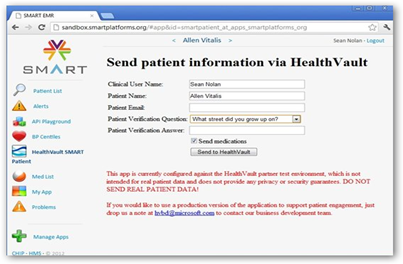 In summary case in point here is yet one more way to get information from an EHR to a PHR. So let’s not get confused here though and think that everything can be written on a plane trip from the east to west coasts, as there were years of coding and research and development that made this effort possible as software and code builds on itself and it keeps getting better when innovative minds get their heads around what can be done. I hope this maybe explains a little bit of the time elements though and the hard work by many to make all of this a reality, a simple format for consumers to get their data. For now, take what you can and make sure you have a record in whatever format you want and can understand how to use, as any PHR and Blue Button information is better than “NO” information. BD
As more companies get behind Blue Button, maintaining
interoperability becomes a more critical requirement. Health Level Seven International (HL7), the international health IT standards body, has adopted Blue Button as an "authoritative interoperability exchange format," and the VA, the Office of the National Coordinator for Health IT, and others are now building an XML-based standardized version of Blue Button data that coincides with the HL7 Consolidated Clinical Document Architecture standard.
The HL7 standard will make it easier to share information with and among health providers and to develop applications and services that aggregate Blue Button data from multiple sources and present data in a simple format. Levin said the industry is moving in a direction "that adds value to the data, that mashes it, that aggregates it, and that shares it not just between patient and provider, but between institutions." Blue Button leadership calls this the Automate Blue Button initiative.
http://www.informationweek.com/government/enterprise-applications/feds-want-wider-use-of-health-records-ap/240007937?pgno=1


Kaydol:
Kayıtlar (Atom)